
Search for an AI partner, and you will find hundreds of firms that all promise the same thing: faster, smarter, more efficient. Some are global consultancies with tens of thousands of employees. Some are software platforms. Some are tight engineering teams that build custom systems. They solve different problems, and choosing the wrong type is the most expensive mistake a buyer can make.
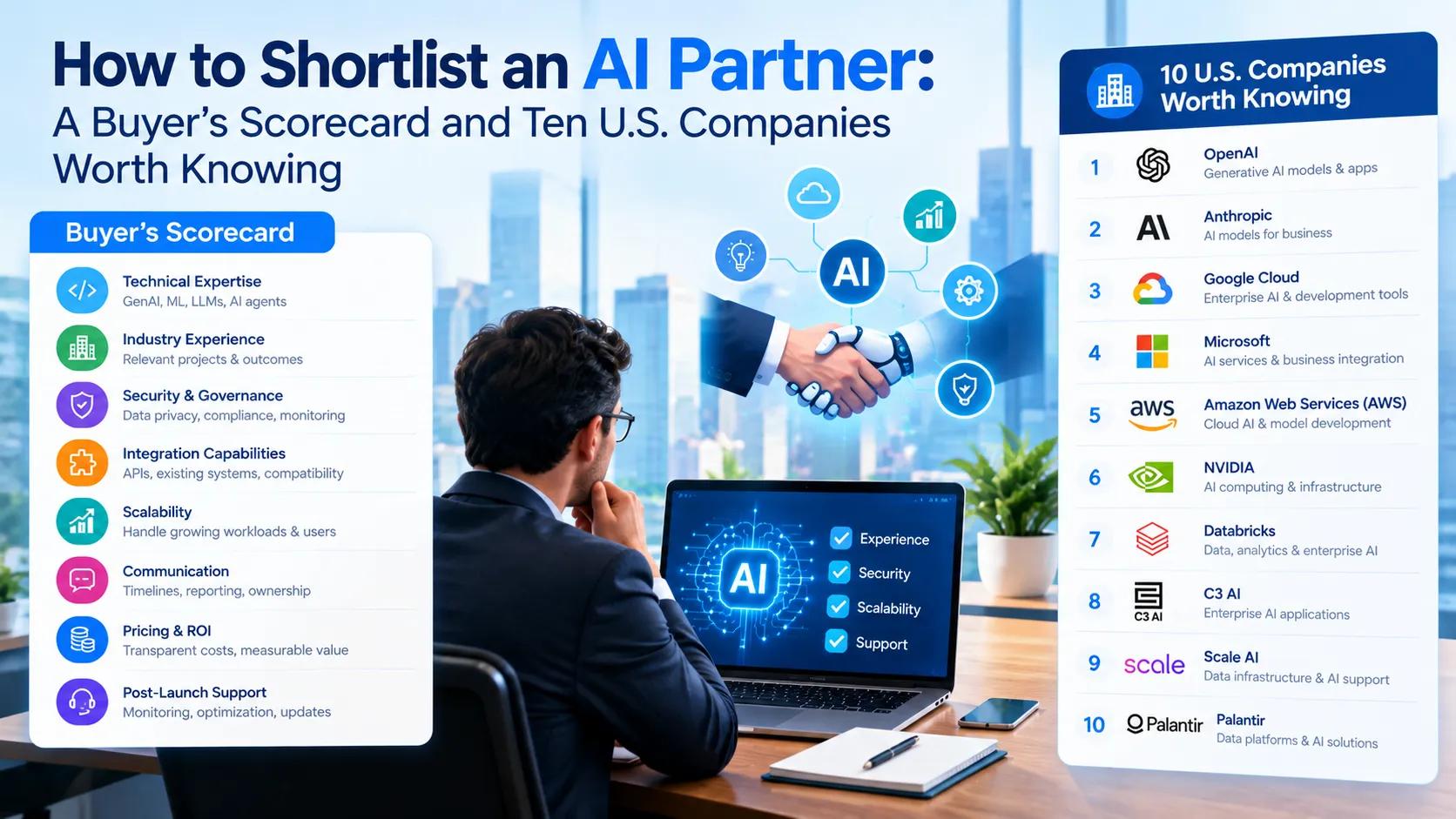
This guide gives you a way to sort the market, a scorecard to compare candidates fairly, a list of established U.S. companies grouped by what they do best, and the red flags to watch for. It is meant as a companion to the longer overview of AI development companies in USA for readers who want a deeper look at the national landscape.
Short answer: pick the type of provider first, based on your problem and internal capability, then compare individual companies on delivery process, evaluation discipline, security, integration skill, and post-launch support, using the same scorecard for each.
The Four Types of AI Providers
Before comparing names, decide which category you need.
Type | What they do | Best when | Watch out for |
|---|---|---|---|
Global consultancy | Strategy, transformation, large-scale implementation | Enterprise change across many functions | Higher cost, junior staffing on delivery |
Platform vendor | Sells software for data, models, or applications | Your need matches a standard product | Lock-in and limited customization |
Specialist engineering firm | Builds custom AI systems and integrations | Your workflow or data is unique | Depth varies, so check references |
Research or model lab | Builds foundation models and APIs | You need a model supplier | Not a services partner |
Many companies use more than one. A common pattern is a platform vendor for data infrastructure, a model provider for language capability, and a specialist firm to build the application and integrations.
Ten U.S. Companies Worth Knowing
This list is illustrative, not a ranking or endorsement. Each entry notes what the company is known for and who it tends to suit. Verify current offerings directly, since products and strategies change quickly.
Company | Category | Known for | Often suits |
|---|---|---|---|
Accenture | Global consultancy | Large-scale AI and data programs across industries | Large enterprises needing broad transformation |
IBM Consulting | Consultancy and platform | watsonx platform and consulting for regulated industries | Banks, insurers and governments |
Deloitte | Global consultancy | AI strategy, risk and governance advisory | Organizations needing governance and audit alignment |
Slalom | Consultancy | Cloud and data projects, with Seattle roots | Mid-market and enterprise cloud modernization |
Palantir | Platform vendor | Data integration and AI platforms for government and commercial use | Complex operational data environments |
C3 AI | Platform vendor | Enterprise AI applications such as predictive maintenance | Industrial, energy and defense settings |
DataRobot | Platform vendor | Machine learning and AI application lifecycle platform | Data science teams that want managed tooling |
Databricks | Platform vendor | Lakehouse data platform and AI tooling | Companies consolidating data and model work |
Scale AI | Data and evaluation provider | Data labeling and model evaluation services | AI developers and public sector projects |
Mobcoder AI | Specialist engineering firm | Custom agents, generative AI and LLM applications | Teams needing hands-on builds and integrations |
Why These Companies Appear
Accenture is one of the largest professional services firms and announced a multibillion-dollar investment in its data and AI practice in 2023. Its scale suits multi-year programs, though smaller projects may fit better elsewhere.
IBM Consulting pairs consulting with IBM's watsonx platform, introduced in 2023, and has long experience in regulated sectors, which matters for governance-heavy work.
Deloitte brings advisory strength in risk, audit, and regulation, and operates the Deloitte AI Institute for research and thought leadership.
Slalom, founded in Seattle, focuses on business and technology consulting with strong cloud partnerships, which makes it a reasonable option for teams modernizing data and applications.
Palantir, based in Denver, built platforms used to integrate disparate data sources and, more recently, launched its Artificial Intelligence Platform for deploying models on operational data.
C3 AI, based in Redwood City, sells prebuilt enterprise AI applications, which can shorten time to value when your use case matches theirs.
DataRobot, based in Boston, offers tools for building, deploying, and governing machine learning and AI applications, and it has expanded toward agent-oriented tooling.
Databricks provides a unified data and AI platform and acquired MosaicML in 2023 to extend its model training capability.
Scale AI supplies data labeling, evaluation, and related services to AI developers, a reminder that data quality drives results.
Mobcoder AI describes itself as a custom AI development company building agents, generative AI, and LLM applications with a model-agnostic approach. It lists partnerships with major cloud and model providers, and it suits buyers who want hands-on engineering for a specific workflow. As with any vendor, ask for references and evaluation details.
Regional Differences That Matter
Where a provider sits matters less than it used to, but local ecosystems still shape expertise.
New York concentrates finance, media, and healthcare, with strong demand for governed, auditable systems. This regional breakdown of the AI development company in New York market explains why the city behaves differently from other tech hubs.
Boston blends university research, biotech, healthcare and robotics, which supports deep technical and life sciences work. See the profile of an AI development company in Boston for how local strengths translate into projects.
San Francisco and Silicon Valley lead in foundation models, infrastructure and developer tooling.
Seattle brings cloud-native engineering culture and strong privacy rules.
Texas, Colorado and the Southeast are growing in energy, defense, logistics and financial services.
A Scorecard You Can Reuse
Give each candidate a score from one to five on each criterion, then weight by importance to you.
Criterion | What to look for | Suggested weight |
|---|---|---|
Relevant experience | Similar projects in your industry and size | 20 percent |
Evaluation discipline | Test sets, accuracy, and hallucination measurement | 20 percent |
Security and compliance | Access controls, data handling, relevant certifications | 15 percent |
Integration skill | Ability to connect with your existing systems | 15 percent |
Delivery process | Milestones, demos, transparent communication | 10 percent |
Post-launch support | Monitoring, version updates, incident response | 10 percent |
Commercial terms | IP ownership, exit rights, pricing clarity | 10 percent |
A candidate who scores high on demos but low on evaluation and support is a risk, however impressive the presentation.
Understanding What You Are Buying
Vendors use the phrase "AI development" loosely. One proposal may cover a single chatbot, another a full program of data engineering, model work, integration, and operations. Before comparing prices, read this explanation of what AI development services actually mean for your business, and then check that each proposal lists the same components, including discovery, data preparation, build, testing, deployment, and support.
Common Pricing Models
Model | How it works | Good for | Risk |
|---|---|---|---|
Fixed price | Set cost for defined scope | Clear, well-understood projects | Change requests can add cost |
Time and materials | Pay for hours or sprints | Evolving scope | Budget can drift without controls |
Dedicated team | Monthly fee for a team | Ongoing development | Needs strong internal management |
Outcome-based | Fees tied to results | Measurable processes | Hard to define and attribute outcomes |
A phased approach often works best: a paid discovery phase, then a pilot, then scale-up decisions based on evidence.
Red Flags When Evaluating Vendors
Guaranteed results without seeing your data or workflow.
No clear explanation of how quality is measured.
Case studies that describe technology but no business outcome.
Reluctance to discuss failure cases or limitations.
Vague terms on who owns code, prompts, models, and data.
Pressure to sign quickly or to commit to a large scope up front.
Heavy reliance on a single model provider with no fallback.
Questions to Ask in Your First Call
Which of your past projects is most similar to ours, and what happened afterward?
How do you measure accuracy and handle errors in production?
What do you need from us in the first month?
How do you protect our data, and where is it processed?
Who will actually work on our project?
What does support look like after launch, and what does it cost?
If we end the relationship, what do we keep?
Frequently Asked Questions
What is an AI development company?
It is a firm that designs, builds, and maintains AI systems for clients, which may include machine learning models, generative AI applications, intelligent agents, data pipelines, and integrations. Some also provide strategy and training.
How do I choose the best AI development company in the USA?
Identify the type of provider you need, then compare candidates using a consistent scorecard covering experience, evaluation methods, security, integration ability, delivery process, support, and contract terms.
How much does it cost to hire an AI development company?
Costs depend on scope, data readiness, integration, and compliance needs. Small pilots can cost far less than enterprise programs. Ask for phased estimates with clear deliverables.
Should I choose a big consultancy or a specialist firm?
Large consultancies suit broad, multi-function programs and heavy governance needs. Specialist firms often suit focused builds and custom integrations, with more direct access to engineers.
Does location matter when hiring an AI partner?
Less than it once did. Local presence helps with workshops and regional regulation knowledge, but process quality, references, and technical depth matter more.
How long does an AI project take?
A focused use case can reach production in about two to four months, while enterprise programs take longer. Data quality and approvals are common causes of delay.
What should be in an AI development contract?
Scope and deliverables, acceptance criteria, IP ownership, data handling and security terms, service levels, change management and exit provisions.
Final Takeaway
The right AI partner is the one whose type, process, and incentives match your problem. Decide what category you need, score candidates on the same criteria, insist on evidence of evaluation and support, and start with a phased engagement that lets results guide the next decision. A shortlist built that way will serve you better than any ranked list of famous names.