
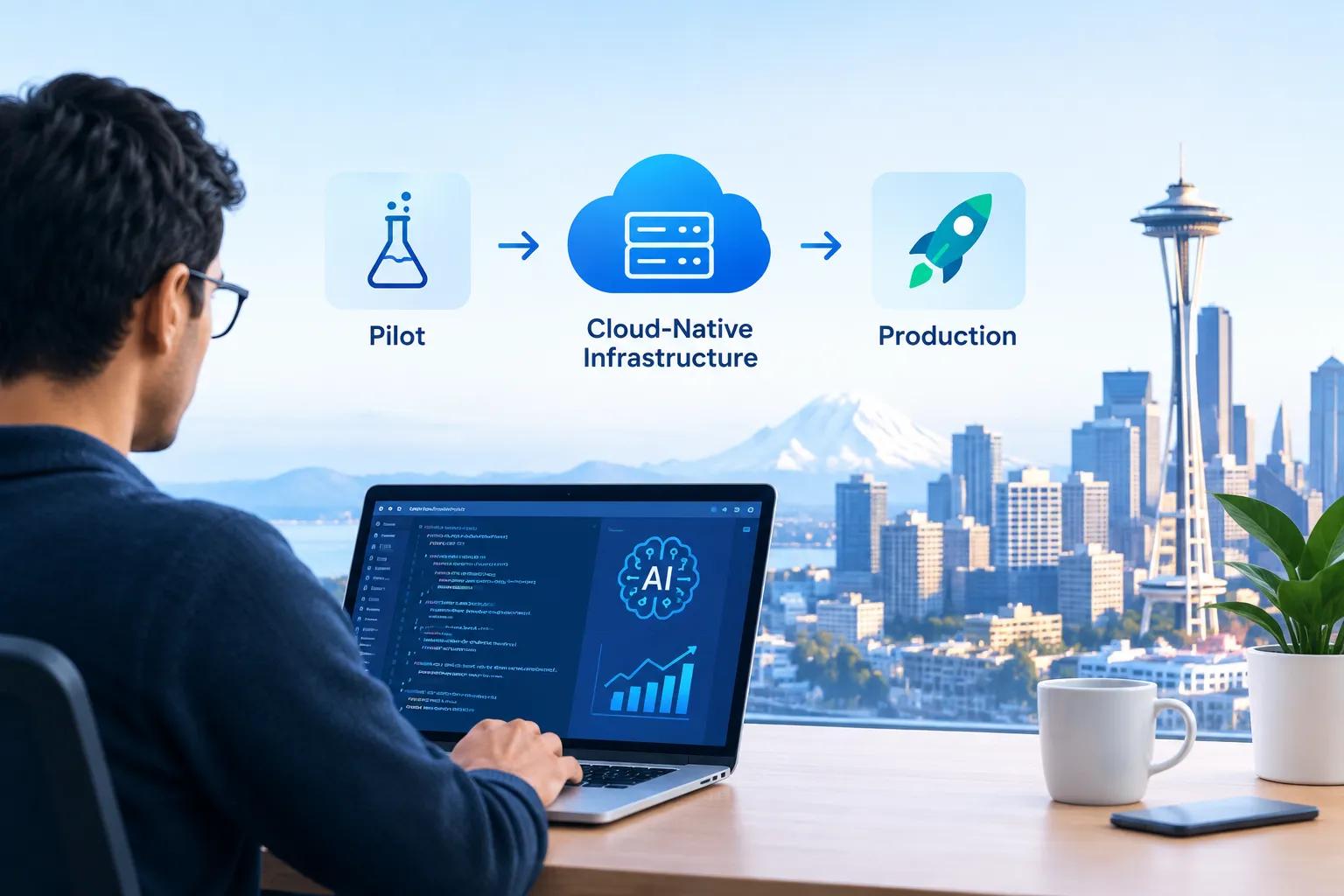
Most Seattle companies do not have an AI idea problem. They have a pilot problem. A proof of concept gets built in three weeks, leadership applauds the demo, and then the project sits in a staging environment for nine months because nobody planned for evaluation, cost control, privacy review, or integration with the systems people actually use.
This guide is for product leaders, engineering managers, and founders in the Puget Sound region who want to close that gap. It covers why the Seattle market is unusual, where pilots typically break, what a production-ready AI build contains, and how to evaluate an AI development company in Seattle without relying on a slick demo.
Short answer: an AI project survives production when it has a measurable success metric, an evaluation suite that runs on every change, a cost model tied to usage, and a privacy design that satisfies Washington law before launch rather than after.
Why Seattle Is a Different Kind of AI Market
Seattle is shaped by cloud computing. Amazon Web Services and Microsoft Azure both grew up here, and a large share of the region's engineers have spent years building and operating infrastructure at scale. The Allen Institute for AI, a nonprofit research institute founded by Paul Allen, adds a strong research culture to the mix.
That creates two effects that smaller companies feel directly.
First, the technical bar is high. When your customers, partners, and even your own staff are used to AWS-grade reliability, a chatbot that times out under load is not a charming prototype. It is a failed product.
Second, talent is expensive and contested. Hiring a full in-house team of machine learning engineers, prompt engineers, and MLOps specialists competes against some of the best-funded employers in the world. Many mid-sized Seattle companies therefore combine a small internal team with an outside build partner.
Washington also has one of the stricter state privacy regimes in the country. The My Health My Data Act, which took effect for regulated entities in 2024, covers consumer health data broadly and allows private lawsuits. Any AI system that touches wellness, fitness, symptoms, reproductive health or similar data needs privacy design from the first sprint.
Why Seattle AI Pilots Stall: Five Failure Points
After watching enough projects, the same patterns repeat. The table below summarizes where pilots usually break and what to do about it.
Failure point | What it looks like | Fix |
|---|---|---|
No success metric | Team says the demo "feels good" | Define one number, such as tickets resolved without escalation, before building |
No evaluation suite | Quality changes silently when prompts or models change | Build a test set of real cases and run it on every release |
Cost surprises | Inference bills triple after launch | Model cost per request early and set alerts |
Integration gaps | AI works alone but cannot reach CRM, ERP, or ticketing data | Scope APIs and permissions in week one |
Late privacy review | Legal blocks launch two weeks before go-live | Involve privacy counsel during architecture |
Notice that only one of those five is about the model itself. Production AI is mostly engineering discipline and governance, and the model is the easiest part to swap.
What a Production-Ready AI Build Actually Includes
A Written Use Case With a Measurable Outcome
Start with a sentence you can test. "Reduce average handling time for tier one support tickets by 25 percent without lowering customer satisfaction" is testable. "Add AI to support" is not. A clear outcome also tells you which data you need and which risks matter.
An Evaluation Layer
Evaluation is the single biggest difference between a demo and a product. Collect a few hundred real examples, including ugly edge cases, and define what a good answer looks like. Run that set automatically whenever you change a prompt, a retrieval index, or a model version. Track hallucination rate, accuracy, latency, and cost together, because improving one often damages another.
For agent-style systems, add tests for decision boundaries. What happens when a tool call fails, when a customer asks for something outside policy, or when two systems return conflicting data?
Cloud-Native Architecture and Cost Control
Seattle teams usually already run on AWS, Azure, or Google Cloud, so the sensible path is to build inside that environment. Managed services such as Amazon Bedrock and SageMaker, Azure OpenAI Service and Vertex AI reduce operational burden. The trade-off is vendor coupling, so keep your prompts, evaluation sets, and retrieval logic portable.
Cost deserves its own design review. Cache repeated queries, route simple requests to smaller models, cap context length, and log token usage per feature so finance can see which AI capability earns its keep.
Privacy and Security by Design
Decide early where data lives, who can see prompts and outputs, and whether a provider may retain data. For sensitive workloads, private deployment or zero data retention configurations can be worth the added effort. Document every data flow, because auditors and enterprise buyers will ask for that map.
Monitoring After Launch
Models drift, providers update versions, and users find new ways to break things. Plan for ongoing monitoring, prompt maintenance, and quarterly reviews. If nobody owns the system six months after launch, quality will quietly decay.
Real Examples From the Seattle Ecosystem
Looking at how local organizations use AI helps calibrate expectations.
Amazon applies machine learning across logistics, forecasting, and product search, and sells those same capabilities to customers through AWS services. The lesson for smaller firms is that most value comes from operational use cases, such as demand forecasting and routing, rather than flashy consumer features.
Microsoft has embedded generative AI assistants across its productivity and developer tools. For enterprise teams, the takeaway is that AI adoption often succeeds when it sits inside tools employees already use rather than forcing a new interface.
The Allen Institute for AI publishes open research and models, which gives local companies a useful reference point for open-source options and responsible research practices.
Textio, a Seattle company, built a writing platform that analyzes job descriptions and workplace communication using language models and data. It shows how a narrow, well-defined problem can support a durable product.
None of these examples are a template you can copy. They show a pattern: pick a specific problem, own the data, and integrate where work already happens.
Where AI Pays Off in Washington Industries
Cloud and enterprise software: semantic search over documentation, support agents with access to account data, and AI features inside existing SaaS products.
Healthcare and biotech: clinical document extraction, scheduling assistants and research tooling, all designed with the My Health My Data Act and HIPAA in mind.
Aerospace and advanced manufacturing around Everett: computer vision for defect detection and predictive maintenance using sensor data.
Ports and logistics around Tacoma: document processing for trade compliance, cargo scheduling and visual inspection.
Retail and e-commerce: product content generation, demand forecasting and customer support automation.
How to Evaluate an AI Development Company in Seattle
Searching for an AI development company in Seattle returns dozens of firms with similar claims. A better approach is to test partners against specific criteria. If you want a wider comparison beyond the Pacific Northwest, this overview of the AI development company in USA landscape explains how national providers differ in size, specialization, and delivery model.
Question to ask | Strong answer sounds like |
|---|---|
How do you measure quality? | A described evaluation process with real test data, not "we test manually" |
Which models do you use? | Model-agnostic reasoning tied to your requirements and budget |
Who owns the IP and the data? | Clear contract terms, with your data kept under your control |
What happens after launch? | Monitoring, drift remediation, and version management in scope |
Can you show comparable work? | Case studies with problem, approach and outcome |
How do you handle privacy? | Specific knowledge of Washington rules and your industry |
One example of a provider that publishes this kind of detail is Mobcoder AI, which describes a model-agnostic approach across OpenAI, Anthropic, Google, and open-source models, along with Pacific time zone-aligned collaboration. Whichever partner you consider, ask to see how they test and monitor, not just what they build.
Before you shortlist anyone, it also helps to understand what AI development services actually include, since one vendor's "AI development" may mean a chatbot wrapper while another's covers data engineering, model work, integration and operations.
A 30-60-90 Day Plan for Your First Production AI System
Days 1 to 30: Decide and scope. Audit workflows and data, rank use cases by expected return and feasibility, pick one, and write the success metric. Confirm privacy requirements and cloud environment.
Days 31 to 60: Build and test. Prepare data, build the first version, create the evaluation set, and integrate with at least one real system. Run internal users through it and collect failures.
Days 61 to 90: Harden and launch. Load test, red team the system with adversarial prompts, finalize monitoring and alerts, train support staff, and release to a limited group before widening access.
After day 90, treat the system like any other product. Review metrics monthly, retrain or retune when quality slips, and expand only when the first use case is stable.
Common Mistakes to Avoid
Starting with the technology instead of a business problem.
Choosing a single model provider without a fallback plan.
Skipping human review in workflows where errors are costly.
Measuring only user excitement instead of operational results.
Leaving legal and security teams out until the end.
Frequently Asked Questions
What does an AI development company in Seattle do?
It designs, builds, and maintains AI systems such as custom agents, generative AI features, machine learning models, and data pipelines, usually integrated with a client's existing cloud environment. The better ones also help with strategy, evaluation, security, and post-launch monitoring.
How long does it take to build a production AI system?
A focused first use case commonly takes about two to four months from discovery to production, depending on data quality and integration complexity. Larger multi-agent or regulated projects take longer.
How much does custom AI development cost?
Costs vary widely with scope, data readiness, and the level of compliance required. A small proof of concept costs far less than a production system with monitoring and integrations, so ask any vendor for a phased estimate with clear deliverables.
Final Takeaway
Seattle companies have access to world-class cloud infrastructure and talent, which raises both the opportunity and the standard. Treat evaluation, cost, and privacy as first-class requirements, choose a partner who can show how they test and operate systems, and start with one use case that you can measure. Do that, and the jump from pilot to production becomes a repeatable process rather than a gamble.